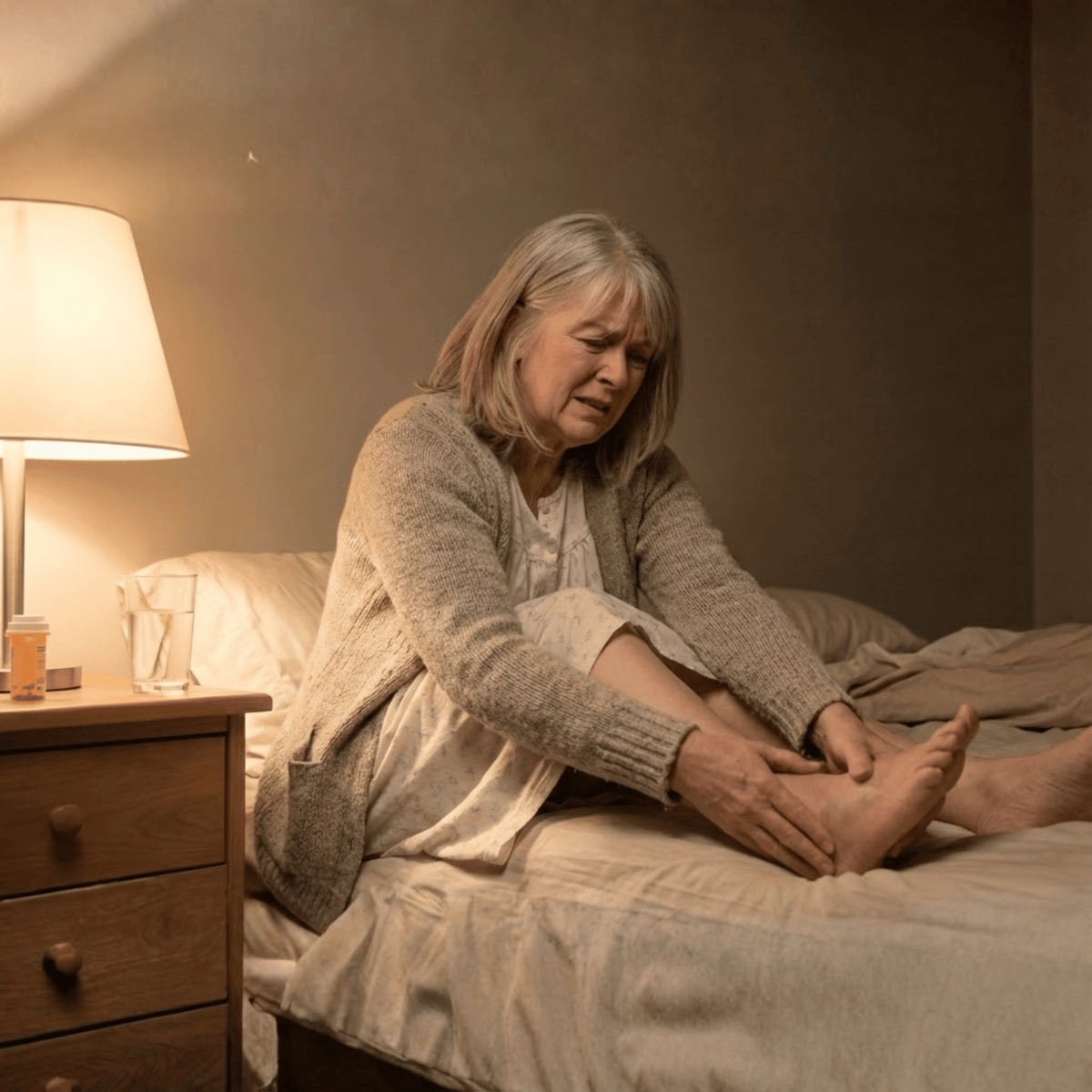
If you've been feeling that burning… buzzing… stabbing… numbness… or that heavy "dead-feet" sensation that makes every step feel less certain than the last — please don't skip this.
I don't say that to scare you. I say it because I wish someone had stopped me and said the same thing before my symptoms spiraled.
Because what you're about to read isn't "advice."
It's the part nobody explains — the part that decides whether things keep getting worse… or finally start getting better.
And here's the part that still shocks me: it didn't take months. It didn't take injections. It didn't take numbing pills.
It started the moment I understood the real cause behind the burning, the numbness, the weakness, the heaviness.
The same cause almost nobody talks about — even though it's the difference between getting better and getting worse.
First, my story
My name is Linda. I'm 59, married to my husband James, with three kids and two grandbabies who light up my whole world.
I was driving to work one morning when I felt something strange in my left foot. A weird numbness in my toes.
I brushed it off. Busy day. But from that moment on, things kept getting worse.
Some mornings I'd stand up and my foot felt like it wasn't even connected to me. I caught myself gripping railings, just in case my balance decided to betray me.

And if I sat too long, standing up felt like my legs were made of wood.
Then came the burning at night.
I'd wake up at 2 or 3 AM to this horrible, fiery sensation in my feet. It felt like someone had dumped hot coals under my skin. There was no sleeping through it. It was relentless.
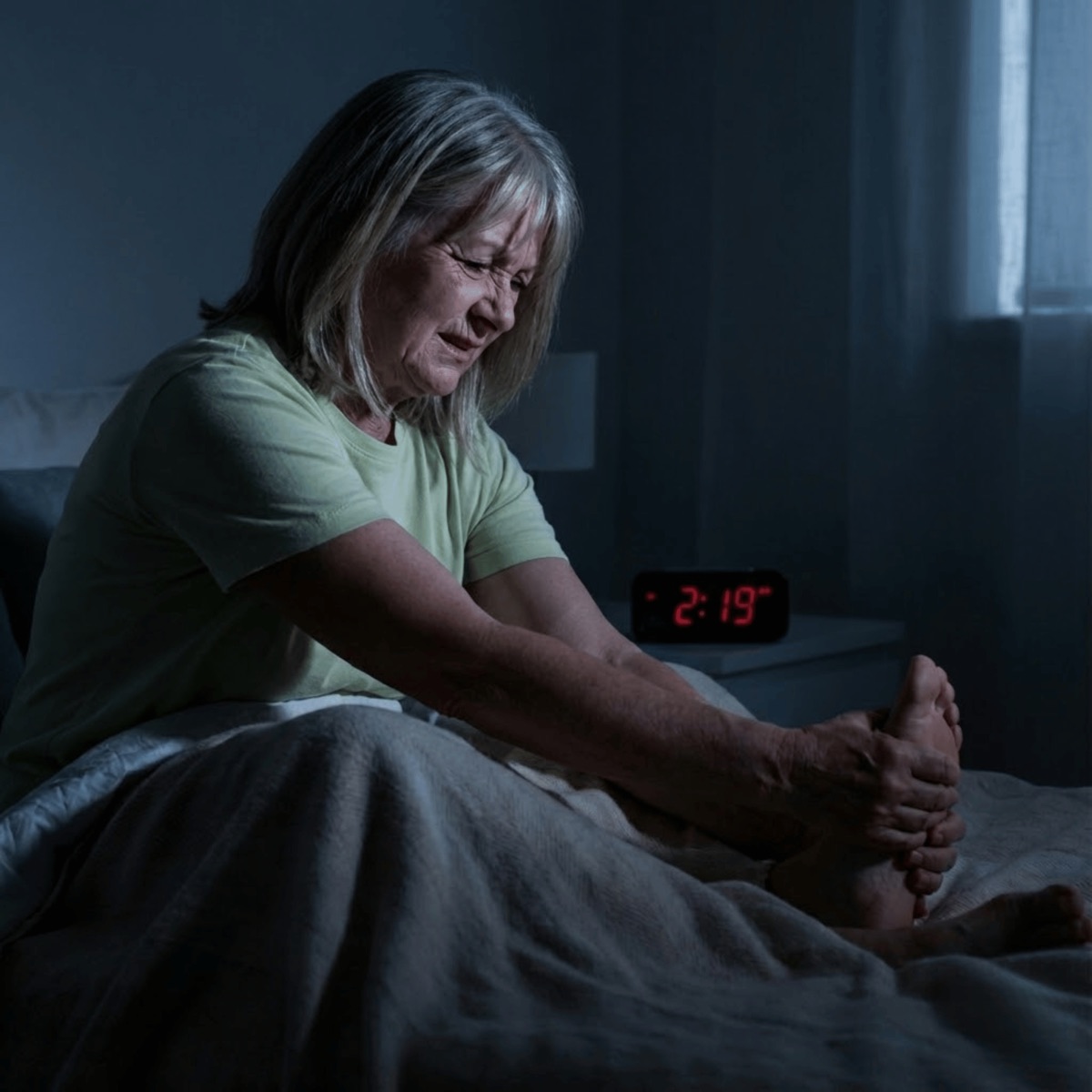
"There's no cure. You can only manage the symptoms."
At that point I went to a specialist. They ran every test under the sun. And then they gave me the news:
Diagnosis: Peripheral neuropathy. Cause? Unknown.
And then the classic line: "There's no cure. You can only manage the symptoms."

My stomach dropped. You're telling me millions of people have this and that's all you've got? Just "good luck, here's a pill"?
And as if that wasn't enough, I also learned that neuropathy can progress to a complete loss of feeling — and in extreme cases, amputation.
That scared the absolute hell out of me. The thought of spending the rest of my life in a wheelchair, unable to run around with my grandkids, felt so unfair. I'm not even that old.

They prescribed gabapentin and Lyrica. At first it helped a little — at the cost of feeling like a zombie all day.
Even taking it only at night, I'd feel foggy the next day, tripping over my own feet. Someone once "joked" that I should be cut off at a social because I wasn't walking straight. I don't even drink.
On the outside, nothing looked out of place. It's not a visible disease — and that's exactly why people who've never felt it can't understand it.

My confidence was shattered. I felt like I was becoming a burden. My whole life turned into a daily cycle of exhaustion, pain, and independence slipping away.
By then I'd tried just about everything. Patches. OTC creams. Vitamin B6. Magnesium pills, magnesium cream. Even those fancy, expensive gadgets I saw online.
Nothing helped. Not only was I drained — so was my wallet.
Honestly, I was ready to give up and accept that this was my life now.
Then I read something that changed everything
One random day, I came across an article. And something in it stopped me cold.
It explained something I had never heard from any doctor. And for the first time in a very long time, I felt hope.

But to understand what it revealed, you first need to understand how nerves actually work.
Every nerve in your body is wrapped in a layer called the myelin sheath — think of it as a protective coat. It keeps the nerve safe and helps signals travel smoothly.
When that coat starts wearing down, the nerve begins to misfire — sending signals it was never meant to send.
That's where the tingling, the burning, and the classic "pins and needles" come from.
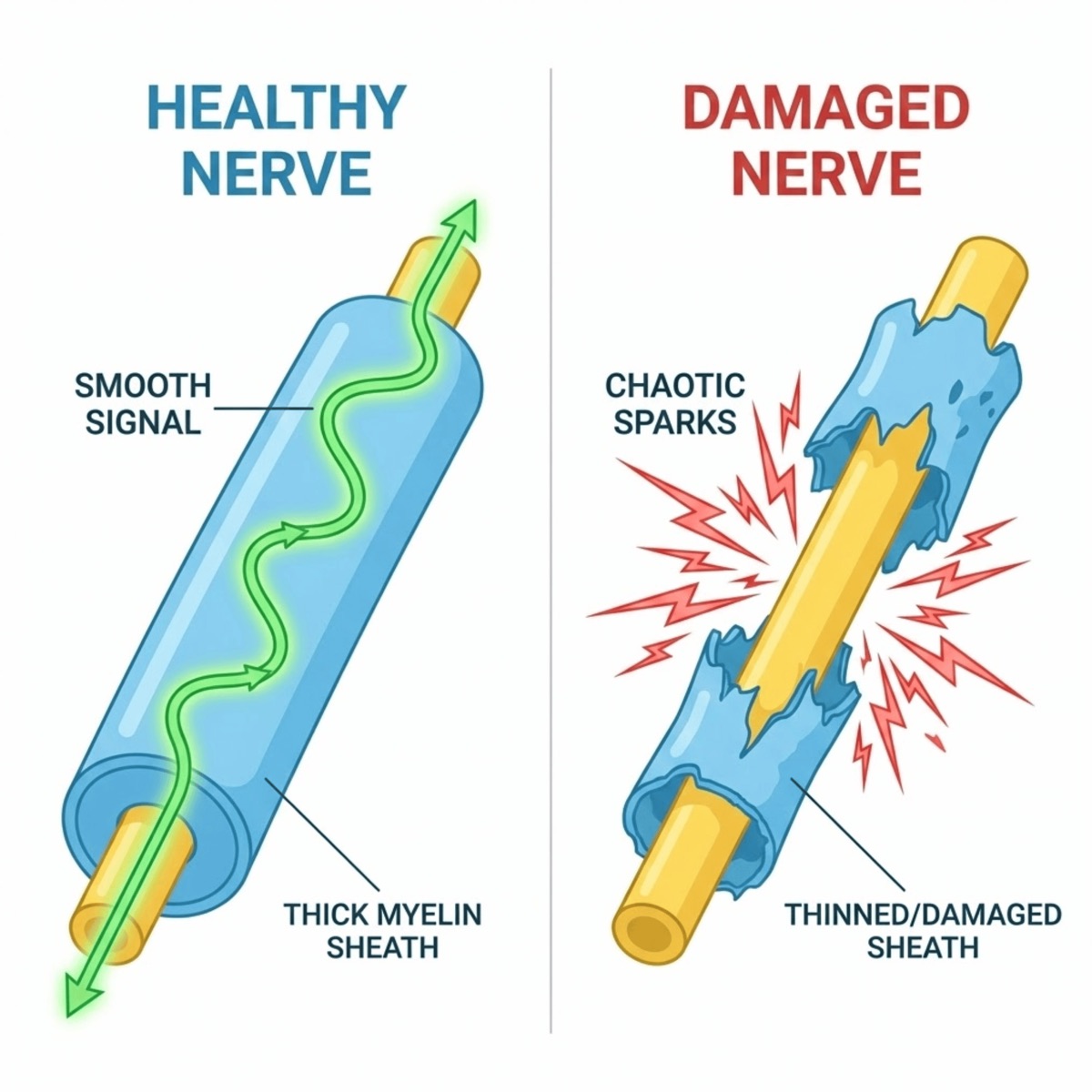
A healthy sheath carries a smooth signal. A damaged sheath sparks chaotically — which your brain reads as burning and tingling.
But here's the part nobody talks about: why does the myelin sheath break down in the first place?
The real culprit isn't age, diabetes, or circulation
The answer is a completely normal function of your body — one that's meant to help you, but has gone rogue.
Rewind the clock. You're 25. You stub your toe on the coffee table.
Within minutes, your toe is hot and throbbing. That throbbing? That's inflammation — and it's a good thing.
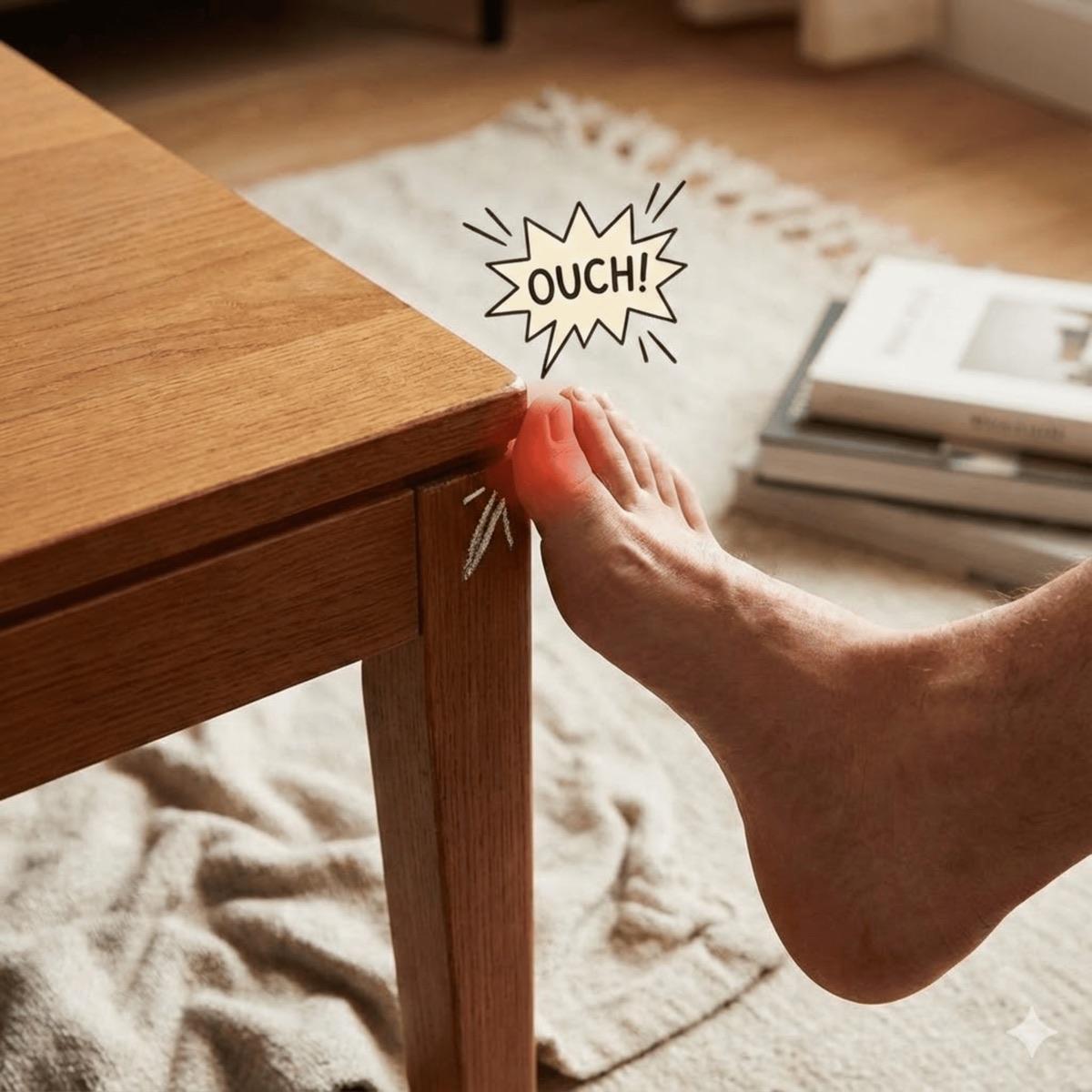
Inflammation's job is to shout "this area needs help, send everything here!" It delivers nutrients, clears out damaged tissue, repairs the area… and then it shuts off.
When you're young, inflammation is a good repairman. Shows up fast, fixes the problem, leaves.
But what happens when it never leaves?
You get what's called the inflammation feedback loop.
As we age — or if we're dealing with poor circulation, blood sugar swings, or old injuries — that shut-off switch stops working the way it used to.
These things don't cause neuropathy. They slow down your body's ability to turn inflammation off.
So here's what happens around your nerves:
A small irritation begins — years of pressure on the feet, blood sugar fluctuations, simple aging, microscopic injuries you never noticed. Your body sends inflammation to repair it, just like it's supposed to.
But instead of shutting off after the repair, it lingers. And instead of repairing, it starts wearing down the myelin sheath.
As the sheath thins, the nerve becomes exposed and unstable. It starts firing burning, tingling and numbness signals for no reason.
And here's the vicious part: those misfires cause more damage. That damage triggers more inflammation. More inflammation causes more nerve breakdown.
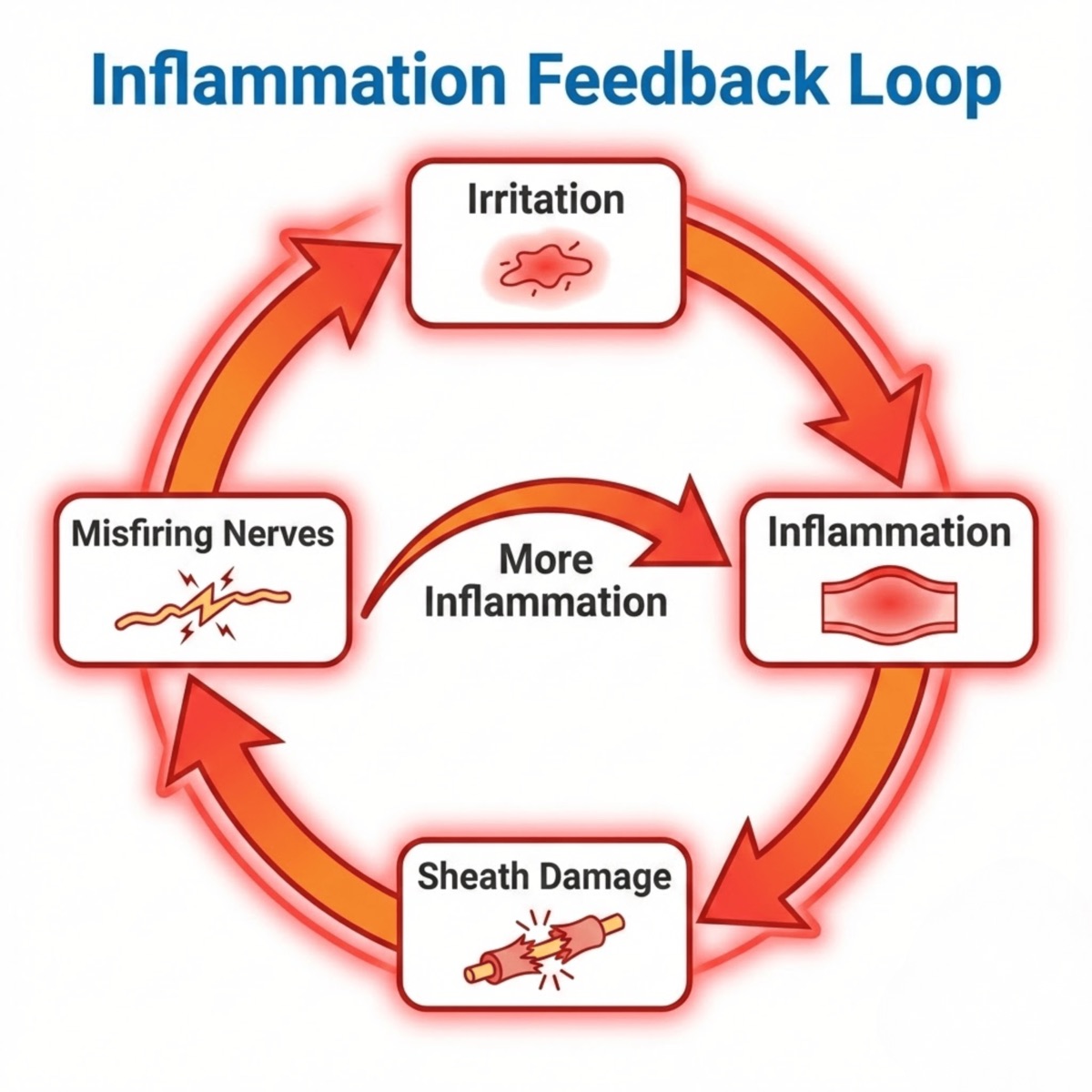
The loop doesn't stop on its own. It's why the tingling spreads, the numbness lingers, and the burning creeps higher.
Left alone, this cycle can destroy the nerves completely — leading to total loss of feeling and, in the most extreme cases, amputation.
It's frightening. Because no one warns you about it.
So how do you stop the loop?
The answer isn't more pills. It isn't numbing creams or pain patches. And it definitely isn't magnesium lotions or vitamin gels that barely reach the surface.
Those things only try to quiet the symptoms. They don't touch the real problem. They don't stop the inflammation loop. And they don't help the sheath rebuild.
What I found next sounded laughably simple:
Obvious, right? But that's when it hit me — none of the things I'd tried ever reached the nerves at all.
Pills have to travel through your stomach, your liver, your bloodstream. By the time anything reaches your feet, there's barely anything left.
Drugstore creams sit on top of the skin. They don't get anywhere near the nerves buried underneath.
Painkillers just numb your brain. They don't do a thing to the nerves themselves.
So of course nothing worked.
The method that had been around for centuries
The approach I came across is not new. It existed long before painkillers, nerve pills, and fancy gadgets.
It came from traditional Asian medicine, where healers used specific herbs to calm inflammation and support nerve tissue through the skin — instead of through the stomach.

They didn't have a scientific name for it. They just knew it worked.
Only recently did naturopaths and natural health researchers give it a proper name: the transdermal nerve reset method.
The idea behind it is surprisingly simple: deliver specific herbal compounds through the skin, so they can calm the inflammation loop and give the myelin sheath the space it needs to rebuild.
And here's what really surprised me: the herbs used aren't random. They contain naturally tiny molecules — small enough to pass through the surface of the skin and reach the deeper tissue where the nerves actually sit.
That was the missing piece.
Once they get there, they help relax the inflammation loop, soothe the irritated tissue, and support the repair of the protective sheath.
What happened to me
The first night I followed it, I felt something I hadn't felt in a very long time. Real relief.
The burning that usually felt like fire under my skin didn't just fade — it dropped fast.
Those heavy, concrete-filled legs I woke up with every morning finally felt lighter. And the sharp, electric jolts that used to hit at a level 9 went all the way down to a level 1.
For the first time in months, my feet felt connected to me again.

Six weeks later: back to walking, back to saying yes, back to being present.
Within a few weeks, the nights got calmer. The mornings stopped hitting me with that overwhelming discomfort. My feet felt "awake" instead of frozen and disconnected.
By week six, the numbness was shrinking instead of spreading. My steps felt secure instead of hesitant. I stopped planning my entire day around pain.
And underneath it all was this steady feeling: I'm getting my independence back.
Where you can see the full explanation
Look — if you've made it this far, chances are your story is a lot like mine.
You know the sleepless nights. The burning that makes you want to cry. The numbness that makes you terrified you'll fall. The constant fear that this only gets worse.
I remember reading stories just like this one and thinking: "What if I wait too long? What if I look back one day and wish I'd tried something sooner?"
That was the part that scared me most. Not just the pain — but losing more of myself every month I waited.
Because neuropathy doesn't pause. It doesn't slow down out of kindness. It keeps going.
So let me say this as plainly as I can: don't wait the way I did.
A researcher recorded a short presentation that walks through this method step by step — the inflammation loop, why the myelin sheath breaks down, and exactly how the transdermal approach works.
It's free, it's about 4 minutes, and it explains it far better than I ever could.
The Ingredients I Found Most Compelling in the Research
Alpha Lipoic Acid (ALA). The ingredient I'd come across most often in neuropathy research. ALA is a fat- and water-soluble antioxidant, which means it can work in both cellular environments. Some clinical research — particularly in diabetic neuropathy — has explored its role in reducing oxidative stress in peripheral nerve tissue. Results vary by individual.
Methylcobalamin (Active B12). I discovered that B12 deficiency is one of the most well-documented nutritional contributors to peripheral neuropathy — and that the active form, methylcobalamin, may be better utilised by the nervous system than cheaper forms like cyanocobalamin. My own levels had never been tested. That changed quickly.
Benfotiamine (Fat-Soluble B1). A fat-soluble form of thiamine that, research suggests, may penetrate nerve tissue more effectively than standard water-soluble B1. Some studies have explored its potential in diabetic neuropathy contexts specifically.
Acetyl-L-Carnitine. An amino acid involved in mitochondrial energy production — particularly in high-energy cells like neurons. Some research has looked at its potential to support nerve cell energy metabolism, with a few small studies showing interest in neuropathic discomfort.
You know the sleepless nights. The burning that makes you want to cry. The numbness that makes you terrified you'll fall. The constant fear that this only gets worse.
Himalayan salt. Renowned for its purity, it is unrefined, and its pinkish color comes from the presence of iron oxide and other minerals such as calcium, potassium, and magnesium
blueberries. They stand out for being rich in antioxidants (such as anthocyanins), fiber, vitamin C, vitamin K, and manganese
Passionflower & Skullcap. Botanicals with a long traditional history for nervous system calm. Some research has explored their role in reducing stress-related sensitisation — which can amplify the perception of neuropathic discomfort — in a gentle, non-stimulating way.